


Baby's behavior shows if he's not getting enough
Since you can't measure how much milk your
exclusively breastfed baby nurses from your breasts, you'll need to rely on reading his behavior to know if he's getting enough.
IT’S NOT A PERFECT WORLD….
In a perfect world, all breasts produce enough milk, and all babies efficiently suckle it out. But, if it were that easy, we wouldn't need breastfeeding specialists, nor would we need all this information you're learning.
Some babies come in for weight checks and their parents are shocked because they haven't gained weight. There seemed to be plenty of wet and poopy diapers. Their baby acted content after feedings (but actually, he lacked energy). He had lots of gas, which seemed to make him fussy (but actually, he was hungry). The exhausted parents didn't realize he wasn't filling out his clothes. So how can you know!?
Weight checks are the only way to know for sure that your baby is gaining weight. That's why we do weight checks and well baby check ups. It doesn't make sense to weigh your baby everyday, so you'll learn to understand your baby's behavior in between those weight checks. The diagram below shows how a baby likely behaves if he’s getting enough to eat once your milk supply is established and your baby is gaining 1oz per day.
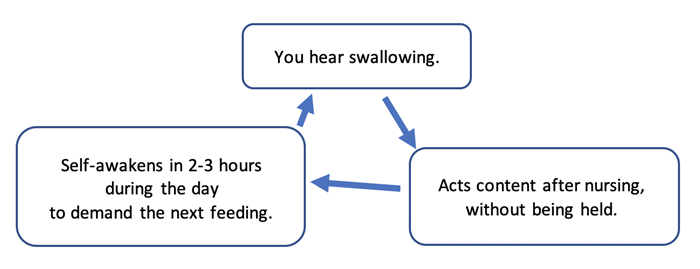
Swallowing Sounds
You must hear the “kah” sound. Jaw or throat movement alone doesn't count. Review the video showing how to accomplish
an ideal breastfeeding session.
You’ll hear lots of swallowing when your full breast lets down and milk flows at the start of a feeding. After several mintues, you’ll hear less swallowing, because your baby already drank a lot of the milk. Compress your breast to prompt your baby to empty the breast.
A Content Baby
Assume hunger if you must hold your baby after a nursing session. Even after the cluster feeding period, hourly nursing sessions do happen, but this shouldn’t be the norm. If this behavior persists, get a weight check. Fussiness means hunger until proven otherwise. Some babies may need a binky to settle down, but in the beginning, the need to suckle means the need for milk.
Waking for Feedings
Babies typically cluster feed around day 3. Some babies then become very sleepy for the next week or so, as they're trying to regain their birth weight. Thus, in the first week or so, you might need to wake your baby for many feedings. Review the video, Normal Newborn Weight Loss.
As time goes on, sleepiness could be normal for your baby, but it also might be from lack of energy due to lack of weight gain. If your baby doesn't start waking on his own during the day, at least every 3 hours, start to start, most of the time, a weight check is needed. Once he gains weight, and thus energy, he should start waking up on his own for more and more of the daytime feedings.
THE DOWNWARD SPIRAL OF MILK SUPPLY
There are a variety of reasons why a baby may not remove milk well, even if there's plenty of milk in the breasts.
Examples
- Baby lacks stamina from being born more than a couple weeks early or being small for dates at delivery.
- Baby is weak from an underlying heart issue or another condition or illness.
- Baby is sleepy from high bilirubin levels (jaundice).
- Baby is sleepy from sedating medications given to Mom, that went through the breastmilk.
- The anatomy of baby's mouth or Mom's nipple makes latching and suckling difficult.
- tongue tie, cleft lip or palate, small lower jaw, small mouth relative to a large nipple
- Positioning baby at the breast is difficult.
- large breasts; baby must wear a harness for hip dislocation; baby has a fractured clavicle from birth trauma.
Start at the box on top.
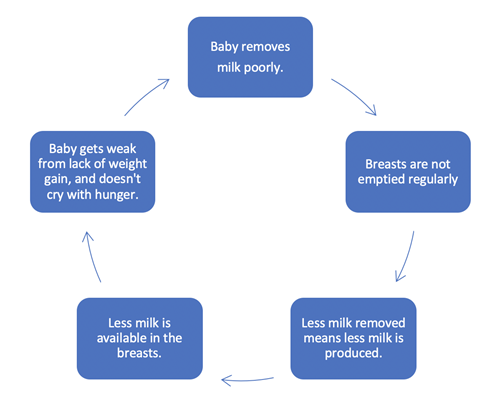
If your baby does not behave like what is shown in the first diagram above, this second diagram shows what can happen.
Get a weight check.
A COUPLE MORE CLUES THAT BABY IS NOT GETTING ENOUGH
Night time
As milk volume increases over time, and the day-night mix up improves, your baby's tummy will hold more milk, so he'll sleep for longer stretches over the night. If your baby suddenly starts waking up more frequently at night, this should prompt a weight check. There are many reasons a baby might be fussy, however, in the early days,......fussiness means hunger, until proven otherwise.
Wets and poops?
You’ll be asked about this a million times. Supposedly, if there’s plenty of wets and poops coming out, there's plenty of milk going in. Is this true? Well.....maybe.
Do you count a diaper that's barely wet? Do you count just a smear of poop - even though this might be with every nursing session, 8 times per day (the gastrocolic reflex)? I've cared for babies who don't poop for a few days, and then they explode with poop. They gained weight just fine.
If in doubt, get a weight check.
TRIPLE FEEDING
Click here to learn about a feeding regimen that helps assess milk supply, assess your baby's ability to remove milk, increases milk supply (if needed), and helps baby gain weight and thus energy to nurse well.
Kay Anderson, MD, IBCLC
5/23