


Nipple Shields
The following information is adapted from the Institute for the Advancement of Breastfeeding Learning and Education.
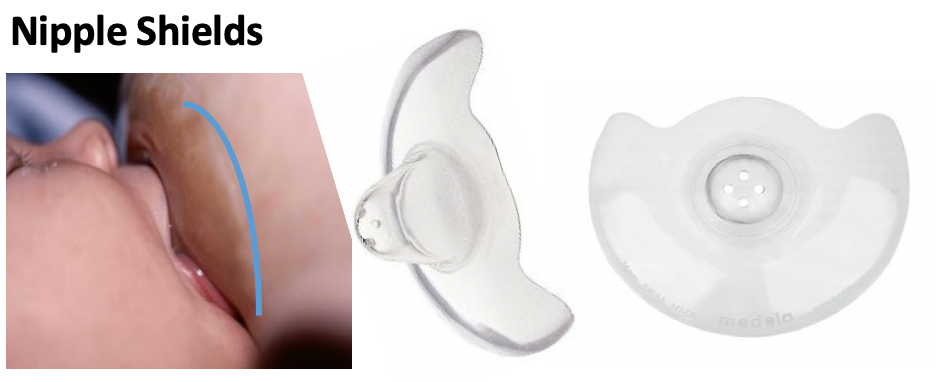
The baby in the picture above is latched onto a soft plastic device that is placed over the nipple.
The blue line shows the edge of the shield. The baby suckles milk through the holes.
There are 3 common reasons for using a nipple shield.
1. The Mom's nipple is flat or inverted.
- If your nipple is "normal" and sticks out from your breast, it's easier for your baby to get the nipple to the roof of their mouth to stimulate the suck reflex.

- If your nipple is flat or inverted, it's difficult to get it to the roof of the mouth to tap the suck reflex.
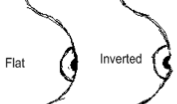
Placing a shield over the nipple taps the roof of the mouth, and off she goes suckling!
2. Your baby has a weak suck reflex. If your baby is premature, or for some other reason, your nipple may not provide a firm enough tap to the suck reflex. The firmer plastic shield triggers this reflex.
3. If your nipples are traumatized, you may not be able to tolerate the latch pain. A shield placed over your nipple provides a barrier between your nipple and your baby's tongue and palate. This way, she is still nursing while your nipples take a break.
Keep trying to latch without the shield.
- Why? Your baby must rely mostly on suction to remove milk when a shield is over your nipple.
- Without a shield, your baby not only sucks, but she compresses the tissue around your nipple, which helps remove milk.
- Some babies never will latch without the shield, but it is better to use a shield than to stop nursing.
- Click here to view a couple videos on latching.
Using a shield in the first couple days of life.
- If your baby will only latch with a nipple shield in the first several hours after birth, pump or hand express colostrum every 3 hours to stimulate your milk to come in better.
- If your nipples are flat or inverted, pumping may pull the nipple out, so it's in a better shape for latching.
- Your nipple may also "come out" as your baby suckles through the shield on your nipple.
- Every once in a while, take the shield off and attempt to latch without it.
Tips for using a nipple shield.
- The Medela brand is best.
- Sizes: 16mm; 20mm; 24mm (most common)
- You must consider the size of your nipple and your baby's mouth.
- Most term babies' mouths are big enough to suckle a 24mm shield.
- It's a problem if the baby has a smaller mouth, and the nipple is large, because a smaller shield won't fit over the larger nipple. In this case, you just have to wait until your baby's mouth grows.
- Nipples are very rarely too big for a 24mm shield.
- If the shield is too big for the nipple, it will often collapse and come off as the baby suckles.
- If the shield is too small, your nipple will feel pinched as your baby suckles.
- Apply water or breastmilk to the inside of the shield to help it cling to your skin better.
- Also, put breastmilk on the outside tip of the shield, so your baby's mouth will slide on easier.
- The cut out portion of the shield should be positioned where your baby’s nose will end up.
- Don't let your baby slide off and on the shield as she suckles, as this will hurt over time.
- The latch should be deep with the mouth open wide and the lips flanged out.
Taking care of a shield.
- Wash it in hot soapy water. Rinse well and air dry.
- Keep it out of reach of pets!
- Store it in a baggie, a denture cup, or
store it between your boobs!
Flat and Inverted Nipples: How to fix them
- Gently roll the nipples between your fingers before latching to make them more erect.
- Pump 1-2 minutes before latching.
- Use the nipple shield to start the feeding.
- Ideally the nipple will "take shape" and pull out so you can slip the shield away and try to latch without it.
- When you remove the shield, dry the area around the nipple so it's not so slippery as you try to latch your baby.
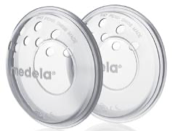
- Below is a picture of a breast shell. You can wear it under your bra during the daytime, but not all the time. It presses the area around your nipple, to force an everted or flat nipple outward. There are several brands available.
Long term shield use.
Don't stress out if you can't wean off the shield.
If you're milk supply is borderline, you may need to do some extra pumping to optimize your milk supply.
However, if you produce milk easily, don't worry about it.
Kay Anderson MD, IBCLC
5/23