


Tongue Tie
Tongue tie is a diagnosis that describes a web of tissue, or membrane, under the tongue that limits tongue movement. The restricted movement results in poor tongue function, and thus poor milk removal. The restricted tongue movement often causes nipple pain.
A membrane under the tongue that does NOT alter tongue function is called a "membrane under the tongue." Most people have at least a little bit of a membrane under their tongue.
A frenotomy is the procedure to cut and remove a tongue tie.
We don't need to cut a simple membrane under the tongue that doesn't restrict movement enough to be a problem.
Since the beginning of time, many babies have been born with a web of tissue under their tongue.
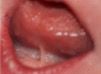

- As pictured, the top end of the membrane attaches to the bottom side of the tongue, at the tip, at the base of the tongue, or anywhere in between.
- The bottom end of the membrane attaches to the floor of the mouth at the base of the tongue, or on the bottom gum - where a tooth will someday come in - or anywhere in between.
Function of the tongue
- A membrane under the tongue might start out stretchy. If it's tight, it might stretch out over time. Newborns need to nurse right away, before it has time to stretch out.
- If a qualified lactation provider assesses the latch and determines the web of tissue limits tongue movement enough to cause latching problems, they can diagnose a tongue tie (ankyloglossia).
- Then, a qualified provider (physician, physician assistant, nurse practictioner, dentist) can perform a frenotomy to cut or laser the membrane. This releases the tethering of the tongue, so it can move better.
How common is this membrane under the tongue?
- It’s hard to say what percentage of babies have this membrane under their tongue, but look under your own tongue - it’s quite common!
- In my experience, at least half of babies have at least a little bit of membrane under their tongue.
- It’s unclear how many of those would qualify as “tongue tie” and thus benefit from frenotomy, because the research is simply confusing.
Below is a summary of what to know as you make an informed decision about a frenotomy.
Further explanations follow below.
Options, Risks and Benefits of Frenotomy
- Ask a lactation expert to evaluate your baby’s latch. There are many factors involved with latching, so there’s no guarantee a frenotomy alone will make a difference every time it's performed.
- Risks of frenotomy include excessive bleeding, infection, feeding refusal, and disruption of nerves and salivary ducts (very rare).
- You will sign a consent form.
- Sterile scissors cut the membrane while the tongue is lifted with an instrument.
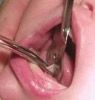
- Anesthesia is not used for newborns, as there are risks of complications that are best avoided.
- Minimal bleeding is most typical. Pressure is applied with gauze for a few minutes.
- It's critical that your baby received the routine Vitamin K shot after birth, as this helps your baby's blood clot.
- Report a family history of bleeding disorders.
- Excessive bleeding is rare. If it happens, a vasoconstriction solution is applied with a cotton ball to slow the bleeding. This is followed by silver nitrate chemical cautery. The resulting chemical burn heals well, but is painful.
- You will latch your baby immediately after the procedure. It's rare for a baby to refuse feedings after a frenotomy.
- Do not massage the wound after the procedure.
- Some recommend wound massage, to avoid reattachment of the tissue. OUCH!
- In my opinion, if it appears that a membrane "reattached," it's likely because the membrane wasn't cut completely the first time around.
- Some people recommend exercises after a frenotomy. They refer patients to specially trained therapists. This can be quite costly, when typical feeding movements will usually provide the exercise needed.
- Some providers do laser frenotomies, as it controls bleeding as the cut is made.
- This method requires a powerful machine.
- It also requires extensive training and experience to avoid lasering too much tissue in such a small space.
- It is very expensive and often not covered by insurance.
To cut the membrane or not?
The decision to perform a frenotomy is based on the healthcare provider’s training, experience, judgement, and desire to help a mom and baby. Find a breastfeeding expert and healthcare provider who will consider all options, including cost. If you trust their opinion, you can make an informed decision.
Just because you see a web of tissue under a newborn's tongue doesn’t mean it needs to be cut.
It will likely stretch over time, and concerns about future speech development are unfounded.1
Many babies latch well despite having a membrane under their tongue.
Before assuming a membrane under the tongue is the cause of a latching problem, you must first consider and address the many other reasons some babies fail to remove milk well and cause pain with latching.
- Perhaps you're not holding your baby correctly at the breast, so his chin is tucked such that he can't open his mouth very wide for a deep latch.
- Perhaps your baby has tight neck muscles on one side after being cramped in the womb for so long. This might make him uncomfortable when he nurses on one breast versus the other.
- Perhaps you're not maneuvering your baby's mouth onto the nipple such that the bottom lip curls out well.
- Click here to review a couple latching videos.
- Perhaps your baby lacks stamina to suckle long enough because he's premature or sick.
- Perhaps you have an underlying physiologic condition that limits how much milk you can make. Thus, your baby may be fussy at the breast because the milk flows too slowly. Or maybe he falls asleep quickly because there isn't enough milk flow to keep stimulating his swallow reflex. A frenotomy won't fix this issue.
- There are too many more reasons to continue to list them.
Sometimes it's just really difficult to decide what to do. Perhaps you just gotta do it and get it over with -- ie, remove this web of tissue variable from the equation, and stop worrying about it. If nursing technique is optimized, all factors are considered, and breastfeeding problems persist, you might decide the potential benefits of frenotomy outweigh the minimal risks of the procedure. And, frankly, it’s easier to do the procedure in a newborn, versus an older infant, child, or adult.
The ongoing controversy about tongue tie
Before the 1990s, frenotomies were rare, as was breastfeeding. As breastfeeding started making a comeback, healthcare providers began looking for reasons why some babies didn't breastfeed well. The focus was on the web of tissue under the tongue. In 2002, a research study was published by the American Academy of Pediatrics which concluded:
- “Ankyloglossia (tongue tie) is a relatively common finding in the newborn population and represents a significant proportion of breastfeeding problems. Poor infant latch and maternal nipple pain are frequently associated with this finding. Careful assessment of the [tongue] function, followed by [frenotomy] when indicated, seems to be a successful approach to the facilitation of breastfeeding in the presence of significant [tongue tie].”, 2
Over the past 15 years or so, frenotomies have increased dramatically. Ideally this means that more babies are able to nurse better. But there is significant concern that unnecessary frenotomies are being done, perhaps out of desperation to try one more thing, or perhaps for financial gain. As with any surgical procedure, the risks and benefits must be considered, including cost.
What about speech?
- It seems reasonable that tongue tie might affect speech articulation. In fact, if you Google this question, you'll read all sorts of things! However, speech pathology experts report that the human brain compensates for the obstacle of restricted tongue movement.
- “There are no data in the literature on any significant association between speech difficulties and tongue-tie in children. Therefore, we cannot recommend tongue-tie [surgery] in early infancy for the indication of the prevention of future articulation problems.” 1
The upper lip tie debate
After about 2010, some folks noticed the thick membrane of tissue under the upper lip of babies.
Somehow, they decided that removing this web of tissue should improve breastfeeding.
Without research to support this claim, the idea has spread like wildfire over social media.
In the past, very few people looked under a baby's upper lip.
Look for yourself, and you will see that at least 9 out of 10 newborns have this thick tissue under their upper lip. And, studies prove this.3
And, they breastfeed fine. It's important that your baby's bottom lip flips out, but the top lip can remain in a neutral position and still get a good seal.
Will there be a space between the upper front teeth some day?
- The membrane under the upper lip appears to shrink as a child's mouth grows bigger, so you likely don't notice it in yourself. Stick your tongue up as far as you can under your top lip, and feel your own membrane!
- In rare cases, a severe web of tissue may persist and leave a gap between the upper front teeth.
- A skilled orthodontist will manage this during treatment with braces. There's no reason to intervene before this time.
Is it reasonable to just remove this variable from the equation, as mentioned above regarding tongue tie?
- I don’t think so, because there's no proven benefit at all. It’s a significant, painful and expensive procedure -- without research to show the upper lip membrane interferes with latching in the first place.
- The Breastfeeding Medicine journal published a review of the research, cited below. 4
More and more mainstream medical research is concluding the same.
Recently, some providers started lasering tissue they call "buccal ties." This is normal tissue that supports the structure of the mouth between the gum tissue and the cheeks. It's normal.
Resources:
1. A.N. Webb et al./International Journal of Pediatric Otorhinolaryngology 77 (2013) 635–646. Volume 77, Issue 5, May 2013, pages 635-646. The effect of tongue-tie division on breastfeeding and speech articulation: A systematic review. Amanda N.Webb, Weibo Hao, Paul Hong. https://doi.org/10.1016/j.ijporl.2013.03.008
2. PEDIATRICS Vol. 110 No. 5 November 2002, pp. e63. Ankyloglossia: Assessment, Incidence, and Effect of Frenuloplasty on the Breastfeeding Dyad. Jeanne L. Ballard, MD, Christine E. Auer, RN, IBCLC and Jane C. Khoury, MS. https://doi.org/10.1542/peds.110.5.e63
3. The Superior Labial Frenulum in Newborns: What Is Normal? Chloe Santa Maria, MBBS, MPH, Janelle Aby, MD, Mai Thy Truong, MD, Yogita Thakur, DDS, MS, Sharon Rea, BA, IBCLC, and Anna Messner, MD. Global Pediatric Health. 2017; 4: 2333794X17718896. doi:[10.1177/2333794X17718896]
4. Upper Lip Tie and Breastfeeding: A Systematic Review. Rizeq Nakhash,1 Natanel Wasserteil,1 Francis B. Mimouni,1,2 Yair M. Kasirer,1 Cathy Hammerman,1,3 and Alona Bin-Nun1,3. BREASTFEEDING MEDICINE Volume 14, Number 2, 2019 a Mary Ann Liebert, Inc. DOI: 10.1089/bfm.2018.0174
Kay Anderson MD, IBCLC
5/23